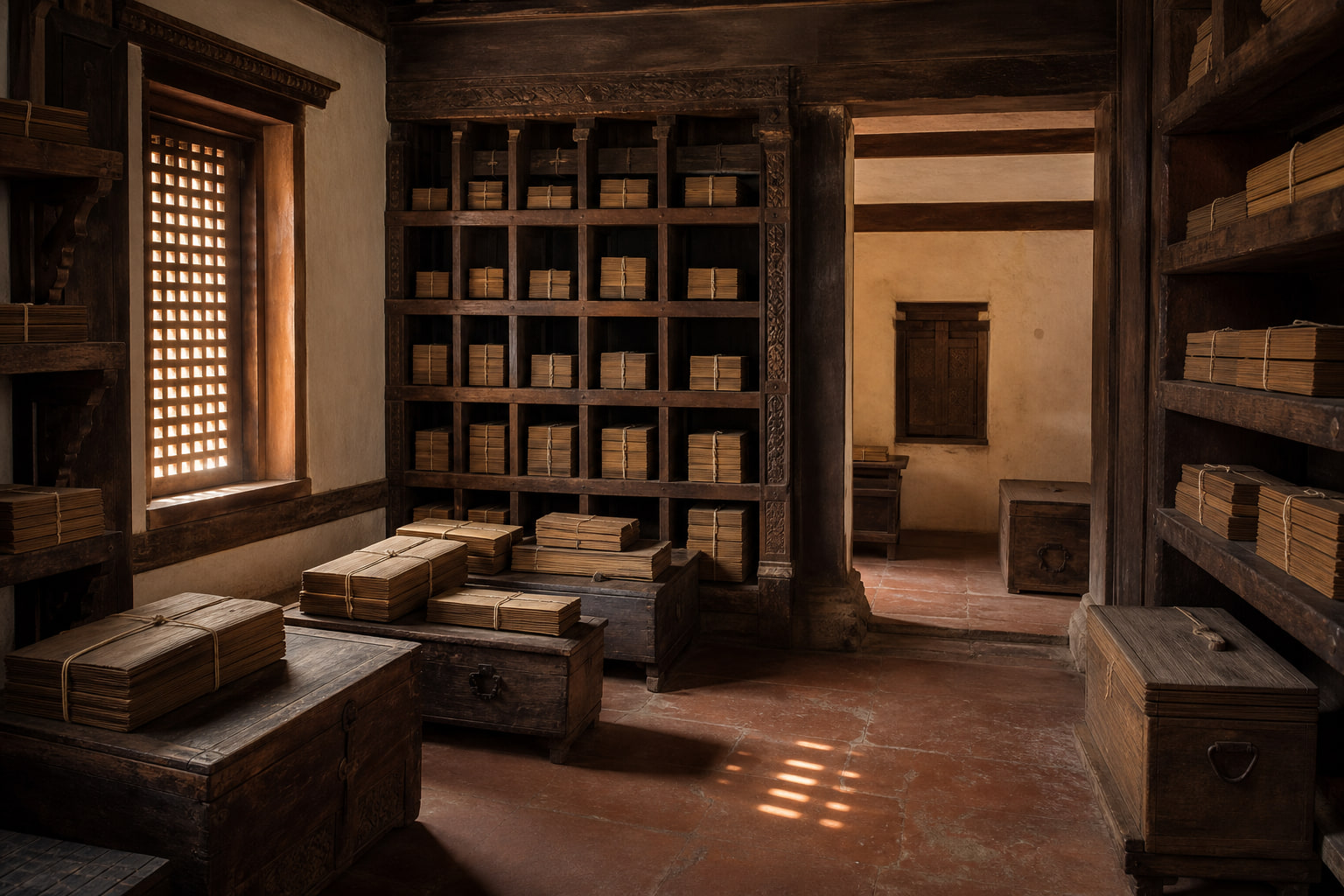
A quiet temple archive with palm-leaf manuscript bundles stored in carved wooden shelves

The Archive

Knowledge Hub

A library for patient learning.

Short answers to the questions students and parents actually ask — what the hands mean, why the bells matter, and who the dancing figure is.

01 · The form

What is Bharatanatyam?

A classical dance form from Tamil Nadu, built on three strands that a dancer learns to hold at once: nritta, pure rhythmic movement with no story; nritya, movement that carries expression; and natya, the dramatic element that turns a dancer into a character.

Its signature is araimandi — the half-seated stance with knees turned out — which almost every movement returns to. It looks simple and takes years, because the whole vocabulary is built on top of it.

In class — Beginners spend their first months on adavus, the basic units of movement. Everything later in the repertoire is assembled from them.

02 · The hands

What do the hand gestures mean?

Hasta mudras are the hand positions a dancer speaks with. They divide into asamyuta hasta, formed with one hand, and samyuta hasta, formed with both. The Abhinaya Darpana is the text most often cited for their names and uses.

A single mudra rarely has a single meaning. Pataka — the flat open hand — can be a flag, a forest, a river, a blessing or a refusal, and only the context, the eyes and the rhythm tell you which.

In class — Students learn the shapes first and the meanings after, because a gesture has to be clean before it can be read from the back of a hall.

03 · The bells

Why does a dancer wear ankle bells?

Salangai are the strings of small bells tied at the ankles. They make footwork audible, so the rhythm a dancer is keeping can be heard as well as seen — and they are unforgiving, because an imprecise foot is instantly obvious to the ear.

Receiving them is traditionally marked by a salangai pooja, the ceremony at which a student is given their bells by their guru. It is the point at which a learner is considered ready to perform.

In class — Bells come later, not on day one. The foot has to be right before it is asked to be loud.

04 · The adornment

Why is the jewellery shaped the way it is?

The performance set takes its forms from temple sculpture, which is where much of the dance's iconography comes from in the first place. The pieces are worn in a fixed arrangement rather than chosen freely.

A full set usually includes the nethi chutti along the parting, jimikki at the ears, a belt at the waist, and the sun and moon set into the hair — ornaments that read clearly from a distance under stage light.

In class — Costume and jewellery are part of the training, not an afterthought. A dancer learns to move in them before their first stage.

05 · The image

Who is the figure in the dancing pose?

Nataraja is Shiva as lord of the dance, shown mid-movement inside a ring of flame. The iconography is deliberate throughout: a drum in one hand, fire in another, one hand raised in reassurance, and one foot lifted.

It is the image a Bharatanatyam class salutes before beginning, and the reason a dancer asks the floor's forgiveness before striking it.

In class — Every class opens and closes with this namaskaram. It is the first thing a student learns and the last thing they stop doing.

06 · The line

Why is a dancer always named with their guru?

Classical dance is not passed on through books. It is shown, corrected and shown again, which makes the teacher part of the record — a dancer's training is described by whose it was.

That is why the lineage is stated rather than implied. It says where a style came from, who shaped it, and who is answerable for how it is carried forward.

The Kalaarnavaa lineage